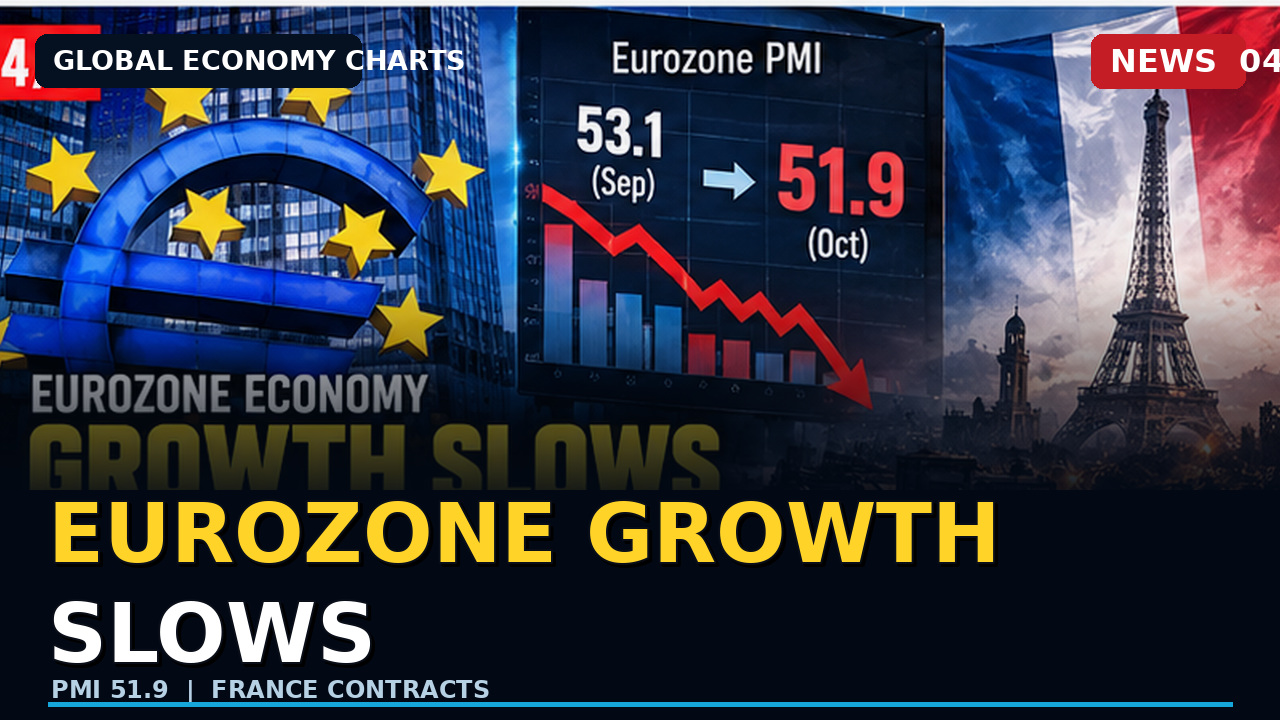

Eurozone PMI Slips to 51.9 as France Contracts and Energy Costs Bite
Europe is still expanding, but growth is slowing unevenly: France has slipped below the PMI threshold while Germany remains above it.
Charts use published survey figures or clearly identified illustrations. PMI readings and sentiment survey indexes are not realized GDP or inflation rates.
BRUSSELS, October 24, 2026 — The eurozone’s flash composite Purchasing Managers’ Index fell to 51.9 in October from 53.1 in September, according to S&P Global. The reading remains above the 50-point level that separates surveyed expansion from contraction, but the decline signals a four-month low in growth momentum. The weakness is particularly uneven: France slipped into contraction while Germany’s private sector continued expanding.
Three economies, three different signals
France’s composite PMI moved down to 48.4 from 51.1 in September, while Germany’s headline composite eased from 53.8 to 52.8. The eurozone aggregate declined to 51.9. Survey readings are diffusion indexes—measuring the balance of firms reporting improvement versus deterioration—not actual quarter-on-quarter GDP growth rates.
| Area | September PMI | October PMI | Signal |
|---|---|---|---|
| France | 51.1 | 48.4 | Contraction |
| Eurozone | 53.1 | 51.9 | Slower expansion |
| Germany | 53.8 | 52.8 | Continued expansion |
Energy inflation complicates the growth picture
S&P Global reports that input-price pressures stayed elevated as the recent rise in oil prices passed through to business costs. Firms may absorb some cost increases through lower margins or pass them on to customers. The first channel depresses profitability; the second can keep inflation stubborn and constrain the European Central Bank’s room to support activity with cheaper credit.
This is not a binary choice between recession and renewed inflation. A weaker activity survey alongside high input costs is a classic policy dilemma: growth risks can rise before measured consumer inflation fully recedes.
Why France matters for European debt markets
French political uncertainty and elevated government borrowing costs are especially relevant because they can weaken corporate confidence and household spending simultaneously. In an integrated monetary union, weaker French activity also affects suppliers, financial institutions and investors beyond the country’s borders. Yet the PMI does not, on its own, establish that sovereign debt is unsustainable.
What investors should monitor
Watch final October PMIs, new orders, employment trends, European natural-gas and oil costs, French sovereign spreads and subsequent consumer-price releases. Above all, distinguish between evidence of current contraction in France and slower—but still positive—activity across the eurozone.
Leave a Reply