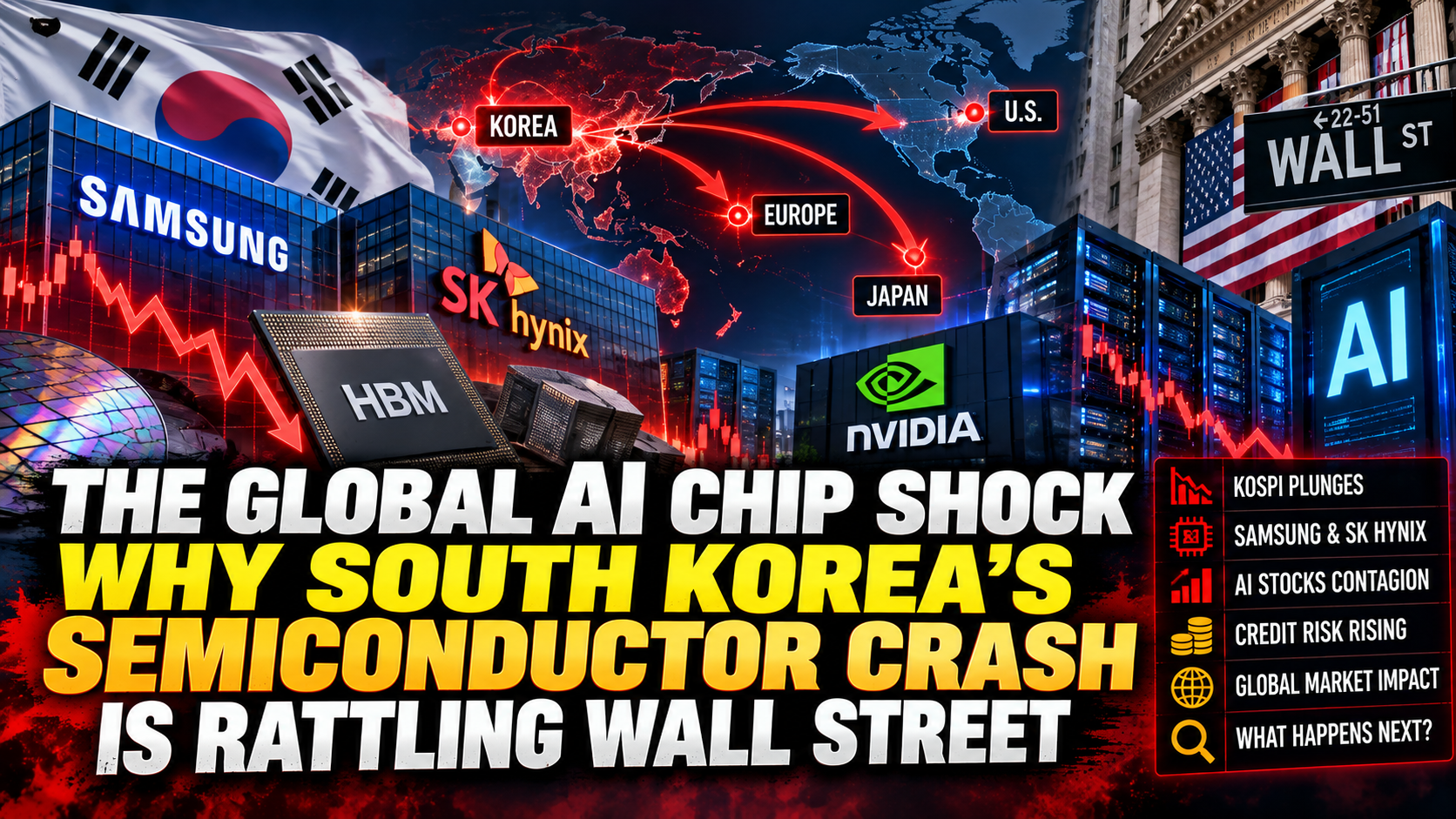

A historic selloff in Seoul exposed a fragile link between AI infrastructure financing, memory-chip expectations and crowded global equity positions.
October 16, 2026 · Independent financial analysis
South Korea’s KOSPI plunged 7.57% on October 15 to close at 5,554.22. An intraday decline of about 8% triggered a 20-minute circuit breaker. Semiconductor heavyweights Samsung Electronics and SK Hynix were among the biggest casualties. Yet the following day brought a sharp rebound, underscoring how difficult it is to distinguish fundamental deterioration from a violent repricing of risk.
The story is larger than Korea. A worldwide reassessment of the profitability of artificial-intelligence infrastructure has coincided with persistent inflation, high borrowing costs and losses among leveraged investment strategies. Korea’s semiconductor concentration makes it an unusually visible barometer of that stress—but it does not prove that Korea caused the U.S. technology selloff.
1. A Shock in Seoul, With Global Origins
Reuters reported that Samsung Electronics was down 9.70% and SK Hynix 11.35% in an October 15 intraday snapshot. Those figures should not be confused with verified closing returns. The Philadelphia Semiconductor Index had already fallen 4.3% in the preceding U.S. session, making this a cross-border repricing rather than a one-way contagion event.

2. Why Korean Memory Makers Matter to AI
Advanced AI servers depend on accelerators, high-bandwidth memory (HBM), conventional DRAM, networking equipment and data-center infrastructure. Samsung and SK Hynix are important memory suppliers in that chain. When investors question the future pace of AI infrastructure construction, expectations for memory demand can adjust rapidly—even before any reduction in actual orders is confirmed.

Equity prices are forward-looking. A falling share price is therefore not evidence by itself that HBM shipments have collapsed. Order books, inventory, contract terms and customer capital-expenditure guidance are better tests of whether the underlying demand outlook has deteriorated.
3. The Credit Channel: AI’s Cost of Capital
The financing model behind the AI buildout is becoming a critical market variable. Large projects require substantial spending before revenue and cash returns fully materialize. Persistent inflation and higher borrowing costs can weaken project economics and increase refinancing pressure, particularly at heavily leveraged infrastructure operators.
Concern about AI infrastructure credit risk, including CoreWeave, has encouraged investors to distinguish between companies with durable legacy cash flows and those that depend heavily on continued external financing. A weaker financing environment could eventually influence data-center spending and semiconductor demand, but the magnitude and timing remain uncertain.
4. Hedge-Fund Losses Reveal a Positioning Problem
Reuters reported on October 16 that Goldman Sachs prime-brokerage data showed global fundamental long-short hedge funds losing 2.9% during the week through October 15. Asia-focused stock pickers lost 2.6% on Wednesday and 6.8% in the first half of October. These figures describe different time windows; they should not be added together or treated as directly comparable daily returns.

Position unwinds can amplify market moves. Still, the published performance numbers alone do not establish that forced liquidation caused Korea’s circuit breaker. A more cautious interpretation is that multiple strategies were simultaneously exposed to the same shift in AI risk sentiment.
5. October 16’s Rebound Does Not Settle the Debate
The Wall Street Journal reported that the KOSPI rebounded 3.6% on October 16, with Samsung up 4.3% and SK Hynix up 3.5% at the time of its report. These were reporting-time readings, not final closing prices. Bargain hunting and improving U.S. market sentiment offered some relief, but a rebound following a steep decline is not proof that financing risks have disappeared.
The durability of the recovery will depend on whether semiconductor earnings expectations stabilize, AI infrastructure borrowers retain access to capital, and hyperscalers maintain their spending plans.
6. A Separate Risk: Competition From China
Chinese memory manufacturers represent a longer-term competitive challenge, particularly in conventional DRAM. Advances in cell architecture, manufacturing scale and customer qualification could affect pricing over time. However, a technology announcement is not equivalent to verified high-volume HBM production or established market share. Competition should be assessed using yields, product qualifications, production volumes and customer adoption rather than headlines alone.
7. Three Scenarios for the Next Six Months

8. What to Watch Next

Conclusion: A Warning Signal, Not Proof of AI Collapse

The October 15 crash and October 16 rebound demonstrate the fragility of sentiment around the AI investment cycle. What remains unproven is an actual collapse in global demand for AI memory or computing. The most important evidence will come from customer spending, chip orders, margins, cash generation and credit conditions—not from any single session’s market move.
Sources
Reuters, Oct. 15 — KOSPI circuit breaker and chip stocks
Reuters, Oct. 16 — Hedge-fund losses in the AI selloff
The Wall Street Journal, Oct. 16 — Asian equity rebound
Aju Press, Oct. 16 — KOSPI closing level and rebound
Figures are labeled as closing or intraday observations. Charts illustrate reported data; flow diagrams are conceptual. This article is analysis, not investment advice.
답글 남기기