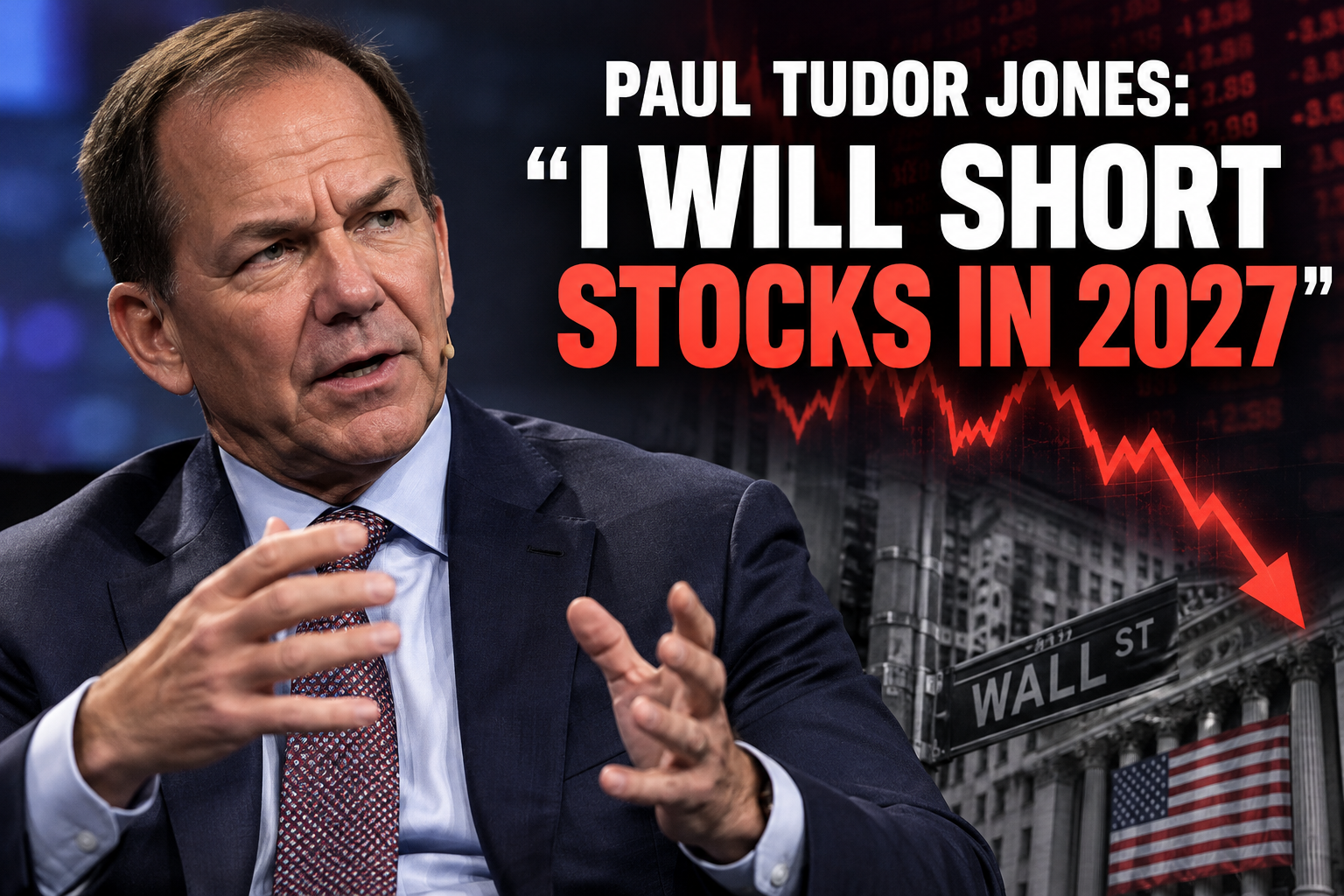
The legendary macro investor sees a dangerous shift in the supply of U.S. shares. But his warning is more nuanced than a simple call for an immediate market collapse.
October 14, 2026 · Global Economy Charts · Analysis

1. The warning that put 2027 on Wall Street’s radar
Paul Tudor Jones, the founder of Tudor Investment Corporation and one of the best-known macro traders in financial history, has put a date on a risk that many investors have been watching for months: 2027. In an October 13 CNBC interview, Jones warned that U.S. equities could face their most unfavorable supply-and-demand environment since 2002.
He also indicated that he expects to be short stocks during 2027. That is a statement of anticipated positioning, not proof that he is already running a large short position today. Crucially, he did not rule out another powerful rally before the trouble arrives.
The difference matters. A market can climb to fresh highs even as the forces that eventually undermine it begin to build.
2. His central argument is about share supply—not just valuations
Investors usually debate whether stocks are expensive by comparing prices with earnings. Jones is emphasizing a different mechanism: the amount of stock that investors must absorb. Corporate buybacks and acquisitions have helped support share demand and reduce the amount of publicly traded equity. Large initial public offerings, secondary offerings and post-IPO lockup expirations could move that equation in the opposite direction.

AI companies are especially important to the thesis. Public offerings from major private technology businesses could attract substantial capital, while early employees and investors may eventually seek to diversify concentrated holdings. An unlock makes shares eligible for sale; it does not guarantee that every holder will sell.
3. Why the dot-com comparison deserves attention—and caution
Jones compared today’s market structure with the late 1990s and the period that followed the dot-com peak. In that era, heavy issuance and successive insider lockup expirations added to the supply of technology shares just as investor enthusiasm became harder to sustain.
The analogy is meaningful because market supply can matter independently of business innovation. Revolutionary technology does not guarantee that every company—or every investor buying at an elevated valuation—will earn a strong return.
But 2026 is not 2000. Today’s leading AI infrastructure and platform companies have different revenue profiles, balance sheets and market positions from many speculative internet companies of the earlier period. The comparison is a warning about possible market dynamics, not evidence that a repeat crash is inevitable.

4. The bond market could become the second pressure point
Jones’s concern extends beyond equity issuance. The U.S. government needs to finance large fiscal deficits, while the AI infrastructure boom demands enormous amounts of private capital. Those borrowers ultimately compete for investors’ savings. If debt supply pushes yields higher, stock valuations can face pressure even without an immediate recession.
Rising Treasury yields may increase the discount rate applied to future corporate profits, particularly for growth companies whose expected earnings lie further in the future. Higher financing costs can also weaken corporate investment and household spending. Jones has warned that unsustainable deficits may eventually force an adjustment, although the timing and form of any adjustment remain uncertain.

5. Why Jones still sees a possible rally before 2027
The most easily misunderstood aspect of his interview is his near-term outlook. Jones discussed the possibility of weakness followed by renewed strength into the end of 2026, citing seasonal patterns around the U.S. midterm-election period and the potential for AI enthusiasm to intensify.
In other words, his longer-term bearish view does not necessarily translate into a recommendation to short stocks immediately. Shorting too early can be costly: equity markets can rise much further than a bearish thesis anticipates, and losses on an unhedged short position can be substantial.
6. Three scenarios for the U.S. stock market in 2027

The key variable is not the headline size of any one IPO. It is the net balance between new equity supply, corporate demand, household and institutional inflows, and the willingness of investors to pay existing valuation multiples.
7. What could happen to bonds, gold, silver and oil?
U.S. Treasuries: A fiscal or inflation-driven rise in yields could hurt longer-duration bonds and expensive growth stocks simultaneously. In a classic recessionary flight to safety, however, Treasury prices might rise instead. The type of shock matters.
Gold: Gold may benefit if investors lose confidence in fiscal sustainability or seek portfolio diversification, but higher real interest rates and a stronger dollar can work against it. It is not a guaranteed hedge against every stock-market decline.
Silver: Silver combines precious-metal sensitivity with industrial demand. It may rise with monetary-hedge demand, yet could underperform gold if a sharp slowdown weakens manufacturing expectations.
Oil: Jones also expressed a bullish view on crude and discussed a possible further increase of roughly $20–$25 per barrel amid geopolitical risk. Such a move could complicate inflation and rate expectations, though it remains his scenario rather than a confirmed price trajectory.
8. A practical investor watchlist

9. How investors can respond without making an all-or-nothing bet
A disciplined response begins with position sizing rather than predicting a precise market top. Investors can review concentration in AI-linked equities, evaluate how their portfolios behave when both yields and volatility rise, and keep sufficient liquidity to avoid forced selling.
Hedging deserves special care. Inverse ETFs, options and outright short positions have different costs, risks and holding-period characteristics. Daily-reset leveraged or inverse ETFs can diverge substantially from a simple long-term inverse of the index, especially during volatile markets.
For investors who believe the 2027 supply thesis, a staged risk-management plan may be more robust than betting everything on one calendar date. Evidence should determine whether the bearish case is strengthening or weakening.
10. The bottom line: watch the supply of capital as closely as the supply of shares
Paul Tudor Jones’s warning is not simply that technology stocks have become expensive. His argument is that the financial system may soon need to absorb unusually large amounts of both equity and debt issuance at the same time. That could change the market’s balance of power from buyers to sellers.
Yet his own outlook leaves room for a final rally before the pressure becomes visible. The right question is not whether investors should blindly copy a famous trader’s anticipated short. It is whether rising issuance, fading buyback support, higher yields and deteriorating earnings expectations begin to reinforce one another.
For 2027, the most important chart may not be the S&P 500 itself. It may be the flow of capital required to keep that index climbing.
Sources and reporting notes
Primary reporting on the October 13, 2026 CNBC interview: Investing.com; Yonhap Infomax; Yahoo Finance / Stocktwits; Yahoo Finance / Benzinga. Quotes and reported opinions are attributed to Jones. The diagrams, scenarios and cross-asset implications are Global Economy Charts analysis.
Disclaimer: This article is for informational purposes only and is not personalized investment advice. Short selling, derivatives and leveraged products involve significant risk.
Paul Tudor Jones · 2027 Stock Market · AI IPOs · Nasdaq · S&P 500 · Dot-Com Bubble · U.S. Treasuries · Gold · Silver · Investment Strategy
답글 남기기