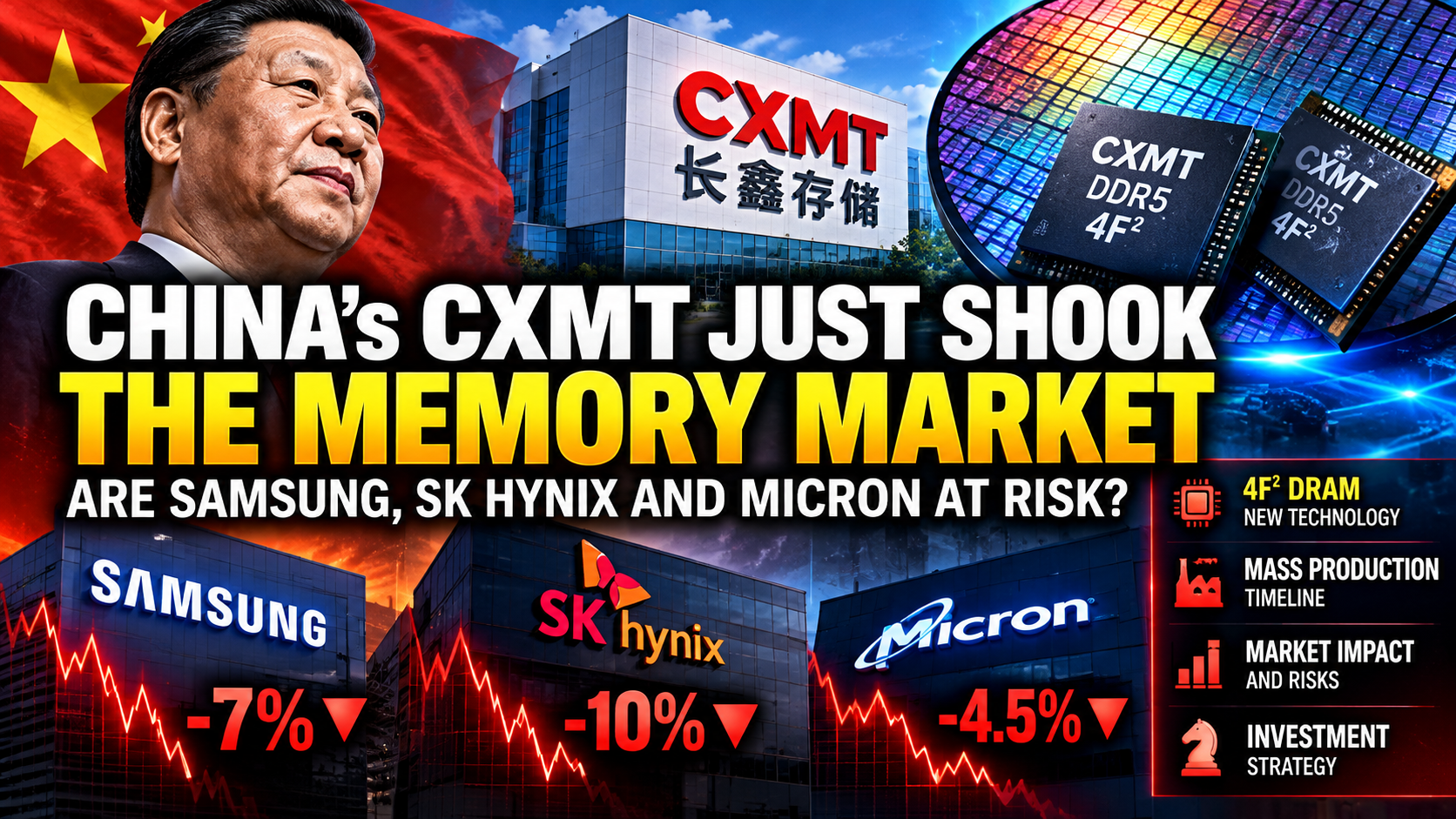
A bold 4F² server-DRAM roadmap has unsettled investors. Here’s what the technology actually means, what remains unproven, and how to prepare for a new phase of memory-chip competition.
GLOBAL ECONOMY CHARTS · OCTOBER 14, 2026 · ANALYSIS
China’s memory-chip ambitions are moving into a more demanding arena: server DRAM. The market should pay attention — but investors need to distinguish a credible technology roadmap from proven high-volume production.

01. The announcement that rattled the memory trade
China’s ChangXin Memory Technologies (CXMT) has put the global DRAM industry on notice. At an October 10 semiconductor conference in Shanghai, company president Cao Kanyu outlined progress on a 4F² memory-cell architecture and a plan to introduce a server-oriented DDR5 registered DIMM (RDIMM) before the end of 2026. The announcement is important because it points toward a higher-value market long dominated by Samsung Electronics, SK hynix and Micron Technology. It is not, however, proof that CXMT has already achieved commercially competitive volume production. Public reporting has not established the new module’s speed, capacity, yield, customer qualifications or shipment volume.

02. Why 4F² matters — and what it does not prove
The F in 4F² represents a minimum feature dimension in semiconductor design. Relative to a conventional 6F² cell, a 4F² layout uses one-third less theoretical cell area at the same F. In principle, a smaller cell can improve density and the number of usable dies per wafer. CXMT has described a vertical surrounding-gate transistor approach intended to address leakage and electrostatic-control challenges. But a one-third reduction in cell footprint does not translate automatically into a one-third reduction in finished chip size, cost or power consumption. Peripheral circuitry, capacitors, manufacturing steps, defect density and packaging all matter. A design milestone is only the first stage of a commercially viable product.

03. The crucial distinction: a product target versus proven mass production
The timeline deserves careful reading. CXMT says it intends to bring a 4F²-based server DDR5 RDIMM to market by year-end. The company has not publicly supplied sufficient information to independently verify production yields, competitive performance or hyperscale customer acceptance. Server memory is particularly demanding: buyers evaluate reliability, error behavior, platform compatibility, qualification time and supply continuity. Even a working demonstration module may take time to become a meaningful share of worldwide server shipments. Investors should therefore track actual qualification and deliveries rather than equating an announced launch date with a supply surge.
04. Why the September G5 announcement is equally important
CXMT’s October statement did not emerge in isolation. On September 20, the company announced that its fifth-generation DRAM platform, G5, had entered mass production and displayed two LPDDR5X products based on the platform. CXMT said its process advances increase dies per wafer by at least 50% compared with the previous generation. That figure is a company claim, not an independently verified industry-wide cost comparison. G5 and the planned 4F² server product are distinct milestones: one is a reported mass-production platform and mobile-memory product family; the other is an advanced server-memory architecture with a future product target. Together, they signal a sustained effort to improve density, broaden the product mix and reduce dependence on foreign suppliers.

05. Why Samsung, SK hynix and Micron are exposed differently
The three established suppliers face overlapping but not identical risks. Samsung has broad exposure across commodity and advanced DRAM, so a credible new competitor could pressure pricing in multiple segments over time. SK hynix has a strong strategic position in high-bandwidth memory (HBM), which serves AI accelerators and is not interchangeable with a conventional DDR5 RDIMM. Micron competes in server DDR5 and advanced memory, but its customer relationships, qualification history and manufacturing execution remain significant advantages. CXMT’s announcement does not demonstrate parity in HBM, nor does it establish that every server customer will immediately adopt a new Chinese module. The threat is most plausibly a gradual increase in competition for conventional and server DRAM, with the pace determined by quality, capacity, economics and access to customers.
06. The market risk is pricing power, not just technology leadership
DRAM is a cyclical industry. When demand rises faster than supply, prices and producer margins can expand sharply. When additional capacity arrives or buyers become cautious, the cycle can reverse. A credible fourth major supplier could weaken the scarcity premium currently attached to portions of the memory market. Yet technology announcements can move equity prices well before earnings are affected. Investors should separate three questions: Can CXMT manufacture the product? Can it ship enough qualified units to matter? And can it do so at costs that change global pricing? Until those questions have evidence-based answers, the precise effect on 2027 profits remains uncertain.
07. China’s strategic advantage — and its constraints
China has a powerful incentive to localize memory supply for smartphones, PCs, servers and AI infrastructure. Domestic demand and industrial policy can support sustained investment even through difficult pricing cycles. But DRAM manufacturing requires sophisticated equipment, materials, process integration, engineering talent and tight quality control. Export restrictions and access to leading tools can complicate scaling. Furthermore, adoption outside China depends on customer requirements and geopolitical considerations. A large domestic market can give CXMT room to grow, but it does not remove the technical and commercial barriers to competing globally.
08. Three scenarios for 2027
In a delayed-rollout scenario, 4F² yields or server qualifications take longer than expected; the near-term effect on industry supply is modest. In a China-first scenario, CXMT gains domestic server customers and gradually reduces incumbent suppliers’ addressable demand in China, while global price effects remain contained. In a global-expansion scenario, competitive costs, high yields and broad qualifications enable meaningful exports, pressuring conventional DDR5 prices and industry margins. These are analytical scenarios, not company guidance or numerical probability forecasts. The distinction between them will be decided by customer adoption and shipments, not conference presentations.

09. An investor checklist: what to monitor next
The most useful evidence will be concrete and repeatable. Watch for published specifications and independent testing of the 4F² RDIMM; announcements of qualified server platforms or named customers; verified production and shipment volumes; contract DDR5 price trends; and revisions to Samsung, SK hynix and Micron’s DRAM margin outlooks. Also monitor whether HBM supply and pricing remain firm, because the economics of AI-focused memory may diverge from mainstream server DIMMs. Rising capacity alone is not bearish if demand grows faster. Falling prices and weaker margins together would be a more meaningful warning.

10. How investors should respond
For existing shareholders, a technology headline alone is a weak reason to liquidate a long-term position. Reassess concentration risk and the original investment thesis instead. For prospective buyers, a sharp share-price decline is not automatically a bargain: compare valuations with normalized rather than peak-cycle earnings and wait for management guidance on pricing and utilization. Investors with large exposure to semiconductor stocks may benefit from liquidity and diversification, especially if leverage could force selling. Gold can play a different portfolio role from equities, but it is not a guaranteed hedge against semiconductor weakness. Silver is more exposed to industrial cycles and can be substantially more volatile. None of these observations constitutes an instruction to buy or sell a specific security.
11. The bottom line
CXMT’s 4F² announcement is a credible strategic signal, not yet a verified commercial breakthrough at scale. It raises the probability of stronger Chinese competition in server DRAM over time while leaving major questions about yield, qualification, production volume and cost unanswered. The near-term investment danger is mistaking a headline for an earnings forecast; the longer-term danger is ignoring a competitor that continues to improve manufacturing capability. Investors should prepare for both possibilities, using evidence on shipments, prices and margins to decide when the competitive threat becomes financially material.

REPORTING AND SOURCE NOTES
- TrendForce, Oct. 12 — CXMT 4F² and DDR5 RDIMM roadmap
- CXMT official announcement, Sept. 20 — G5 mass production
- Tom’s Hardware, Oct. 13 — specifications and yield questions
- Seoul Economic Daily, Oct. 12 — 4F² roadmap and commercialization uncertainties
- DIGITIMES, Oct. 12 — planned server DDR5 product
Reporting cut-off: October 14, 2026. All forward-looking scenarios and investment implications are independent editorial analysis. Company claims are identified as such. No live stock prices are asserted in this article.
답글 남기기