It Wasn’t the Boston Tea Party — It Was About Gold and Silver
History, as commonly taught, is often boring.
In textbooks, we learn about the Boston Tea Party and are told that, somehow, this event eventually led America into a war for independence.
When I was in middle and high school, I memorized these things simply because they were going to be on the test.
“Boston Tea Party.”
Tea, like the drink. I just memorized it that way.
But if you ask AI today to explain what textbooks say caused the American Revolutionary War, you will usually get a familiar answer.
1. Britain Abandons Its Policy of “Salutary Neglect”
Until the mid-18th century, Britain had generally maintained a policy known as “Salutary Neglect,” allowing its 13 North American colonies considerable autonomy without excessive interference.
Then came the Seven Years’ War, also known as the French and Indian War.
Britain defeated France and emerged as the dominant power in North America, but the war left Britain with an enormous national debt.
2. Britain Imposes More Taxes on the Colonies
Facing serious financial pressure, the British Parliament began arguing that the colonies, which had benefited from the war, should also help pay its costs.
This led to new taxation policies.
The Sugar Act of 1764 imposed duties on sugar and imported goods entering the colonies.
The Stamp Act of 1765 required stamps on newspapers, legal documents, playing cards, books, and other printed materials.
The backlash from the colonists was so intense that the Stamp Act was repealed about a year later.
3. “No Taxation Without Representation”
The colonists argued that they had never elected representatives to the British Parliament.
Therefore, they believed Parliament had no legitimate right to impose taxes on them unilaterally.
This gave rise to the famous slogan:
“No taxation without representation.”
Boycotts of British goods followed.
4. The Conflict Escalates: The Boston Tea Party
In 1773, Britain passed the Tea Act, granting the East India Company special privileges in the colonial tea trade.
Colonial merchants strongly opposed it.
On December 16, 1773, colonists disguised as Native Americans boarded British ships in Boston Harbor and dumped chests of tea into the water.
Britain responded harshly.
Boston Harbor was closed, and Massachusetts lost much of its political autonomy.
5. The Revolutionary War Begins
In 1774, representatives from the 13 colonies gathered in Philadelphia for the First Continental Congress and agreed to resist British oppression together.
Then, in April 1775, armed clashes between British forces and colonial militia at Lexington and Concord marked the beginning of full-scale war.
That is roughly how textbooks explain the American Revolution:
British mercantilist control and unfair taxation versus colonial self-government and resistance.
But look at that explanation again.
We are told about autonomy, national debt, the Sugar Act, Stamp Act, Tea Act, and Boston Tea Party.
Yet there is almost no discussion of gold, silver, or the Bank of England.
And that is where the real story begins.
Gold, Silver, and the Bank of England
The real reason America ended up fighting a full-scale war with Britain, in my view, was not simply the Boston Tea Party.
It was about gold and silver.
That is the heart of this story.
Think about it.
A few hundred boxes of tea were dumped into Boston Harbor, and that eventually resulted in a massive war?
When you look at history only in that way, it can feel disconnected.
The real question is:
What chain of events connected the colonies, gold, silver, the Bank of England, and eventually a full-scale war?
Why did Americans become so angry that they were willing to fight Britain?
The main characters in this story are money—and particularly silver.
Real money.
Benjamin Franklin and Colonial Script
Benjamin Franklin spent more than a decade in Britain studying monetary affairs before returning to the colonies.
The American colonies were using an independent form of credit money commonly referred to as Colonial Script.
Franklin was no ordinary man.
Everyone knows about his experiments with electricity and the lightning rod.
The lightning rod works by directing lightning into the ground so that buildings are not destroyed.
Franklin’s work with electricity helped save countless lives.
He died before the Nobel Prize existed, so he obviously never received one.
And remember the word “battery”?
Benjamin Franklin helped popularize that term as well.
He experimented with connecting early electrical storage devices together. The arrangement reminded him of a military battery—a group of artillery pieces.
That is one of the origins of our modern use of the word battery.
Franklin was also deeply involved in politics and monetary affairs.
He represented the colonies and later became one of America’s most famous Founding Fathers.
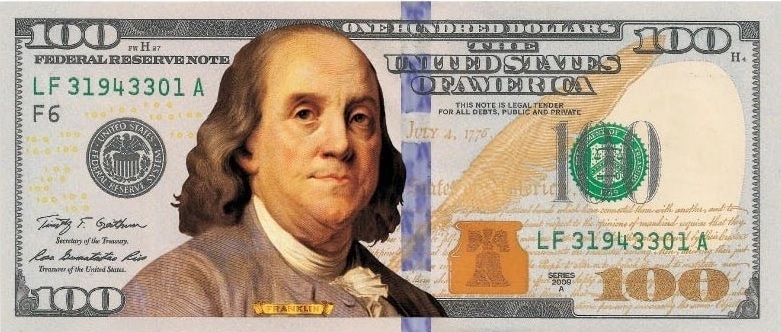
That is why Benjamin Franklin appears on the $100 bill, the highest-denomination U.S. note in ordinary circulation.
Franklin was an extraordinary man.
But let us leave his lightning rods and batteries behind and move into the monetary side of the story.
America Had a Serious Money Problem
At the time, the American colonies belonged to Britain.
Britain was steadily absorbing gold and silver from the colonies, creating a serious shortage of money.
Benjamin Franklin and other colonial leaders supported the use of Colonial Script as a local currency.
It was not a traditional gold-standard currency.
It functioned more like fiat money.
Different colonies issued different amounts according to local economic needs, and in many places the system worked remarkably well.
And here is the important part:
Because this money did not originate as interest-bearing debt, the colonies did not necessarily have to pay interest to someone simply for the money to exist.
Would Britain simply stand by and allow that system to continue?
The City of London and the Bank of England
Long before this, Britain had established a powerful financial center within London.
The City of London is effectively a historic financial district with its own unique institutions and traditions.
It is not simply another neighborhood of London.
The Bank of England was at the center of Britain’s financial system.
Government debt and interest were deeply intertwined with this system.
So why should a country have to borrow money at interest from a banking system in order to finance itself?
That question becomes important when we look at what was happening in the American colonies.
If Franklin’s colonial money worked too well, the colonies could potentially become increasingly independent of Britain’s financial system.
From the perspective of financial interests already controlling Britain’s monetary system, that was a serious problem.
So in 1764, Parliament passed legislation restricting the colonies’ ability to issue their own paper currency.
And taxes owed to Britain increasingly had to be paid in hard money—gold and silver.
That changed everything.
Gold and Silver Were Drained Out of the Colonies
The British government—and the financial powers behind the monetary system—understood what real money was.
Gold and silver.
The American colonies had relatively little manufacturing capacity at the time.
They had to import industrial products, clothing, weapons, and many other goods from Britain.
They also had to pay taxes to Britain.
And when all of those obligations had to be settled in gold and silver, specie inevitably began leaving the colonies.
The colonies did have another way to obtain silver.
Through trade involving molasses and sugar, Spanish silver coins could enter the colonial economy.
But Britain then introduced measures such as the Sugar Act, disrupting those trade flows.
The Stamp Act added further financial pressure.
So what happened?
Gold flowed to Britain.
Silver flowed to Britain.
Sources of incoming Spanish silver were constrained.
And the colonies’ ability to issue their own paper money was restricted.
Money itself began disappearing.
Trade became increasingly difficult.
Take Away the Money and What Happens?
Imagine someone you know who always insists on paying whenever you eat together.
Every time you go out, he says:
“I’ll pay.”
At first, maybe you appreciate it.
But if it happens every single day, eventually you might start feeling uncomfortable.
Now imagine something far more serious.
Britain was not simply asking the colonies to pay for tea.
From the colonial perspective, Britain was steadily extracting the real money—gold and silver—out of their economy.
At the same time, Britain restricted the colonies’ ability to create their own currency.
Then it demanded taxes in hard money.
If you take away someone’s gold, take away their silver, restrict their ability to issue money, and then demand taxes in silver—
what are they supposed to do?
This, in my view, is the real background to the American Revolution.
The Boston Tea Party was not the fundamental cause.
The monetary conflict had already begun.
Nobody Died at the Boston Tea Party
On December 16, 1773, nobody was killed during the Boston Tea Party.
There was no major battle between soldiers and protesters.
No crew members were killed.
No violent massacre occurred.
The protesters boarded ships and dumped 342 chests of tea into Boston Harbor.
That’s it.
Yet today this event is often presented as one of the central causes of the American Revolutionary War.
Does that really explain why Britain and the colonies eventually fought a full-scale war?
The deeper question is:
Why were Americans already so angry?
They had lost gold.
They had lost silver.
Their ability to bring in additional silver was being constrained.
They were still expected to pay taxes in silver.
And if the existing monetary system continued, the colonies would increasingly have to depend on a financial structure based on debt and interest.
Americans noticed what was happening.
The Bank of England and Debt
At the center of Britain’s financial system stood the Bank of England.
The identities and structure of its early shareholders have long attracted controversy and speculation.
The broader point, however, is the relationship between government debt, interest, and monetary control.
Why does government debt pay interest?
Who receives that interest?
And why should the state depend on borrowing in order to finance itself?
Modern central banking raises many of the same questions.
In the 1970s, economic policymakers increasingly emphasized raising interest rates to fight inflation.
But if interest rates rise, doesn’t the cost of debt also rise?
There are always people who benefit from higher interest payments.
Follow the money.
Now return to colonial America.
Gold and silver were scarce.
Debt became difficult to repay.
Businesses failed.
Colonists who already distrusted Britain’s financial system became increasingly furious.
Then Britain introduced the Tea Act.
The anger exploded.
But Britain miscalculated something.
The Tea Act Was More Than a Tax Issue
Around 85% of the tea consumed in the American colonies was reportedly being obtained through Dutch and other non-British channels.
Meanwhile, the British East India Company had enormous inventories of unsold tea.
The Tea Act gave the company special advantages that allowed it to sell tea more cheaply in the colonies.
From a purely market perspective, consumers might have been expected to welcome cheaper tea.
But there was a catch.
Britain was effectively granting the East India Company a privileged position in the colonial tea market.
Colonial merchants who had previously imported and distributed tea could suddenly be pushed aside.
Imagine a large corporation receiving government-backed privileges that allow it to dominate your local market.
Today it’s tea.
Tomorrow it could be coffee, juice, or anything else.
And every time colonists consumed these products, taxes would continue flowing back to Britain.
Many Americans saw the direction in which this could go.
They did not merely see a tax.
They saw a growing system of economic control.
Britain Misunderstood the Americans
Britain made one enormous mistake.
It underestimated what kind of people it was dealing with.
Many of the people who crossed the Atlantic to settle in America were willing to endure extraordinary hardship.
They crossed dangerous oceans.
Some were attacked by pirates.
Some faced hunger, disease, and death.
They endured all of this for one thing:
Freedom.
For many of them, freedom was valuable enough to die for.
Britain had dealt with many colonies before.
But the Americans were different.
When Britain continued tightening economic controls, many colonists reached a simple conclusion:
If Britain continued down this path, there would be war.
The Boston Tea Party Was a Warning
The colonists did not simply destroy everything in sight.
On the night of December 16, 1773, dozens of colonists boarded the ships and threw 342 chests of tea into the harbor.
They deliberately targeted the tea.
They did not indiscriminately destroy the ships.
They did not kill people.
The death toll was zero.
That matters.
The message was essentially:
“We are angry, but this is still a warning. Do you really want this to become a war?”
Britain, however, had its own pride.
King George III and Parliament viewed the Boston Tea Party as a direct challenge to royal authority.
Britain responded by closing Boston Harbor, restricting Massachusetts’ self-government, and increasing direct control.
By then, the colonies were already suffering from a shortage of gold and silver.
The atmosphere became explosive.
Then, in April 1775, the Battles of Lexington and Concord began the Revolutionary War.
And from this point onward, money became an even bigger problem.
Continental Currency
The Continental Congress needed enormous amounts of money to finance the war against Britain.
So it began issuing a new paper currency:
Continental Currency.
But this currency was not directly redeemable for gold or silver.
At first, it functioned.
But as more and more notes were issued, the supply exploded.
Britain also engaged in counterfeiting operations designed to undermine Continental money.
Counterfeit notes were distributed in large quantities.
The result was devastating inflation.
Britain later used similar monetary warfare against France after the French Revolution, targeting the French Assignat currency.
Britain had considerable experience in this field.
Eventually, Continental Currency suffered the fate that many fiat currencies suffer when issuance becomes excessive.
Initially, it traded near parity with Spanish silver.
But within roughly six years, the exchange rate deteriorated dramatically—eventually approaching 40:1 and even 1,000:1 in some accounts and circumstances.
The currency effectively collapsed.
What Benjamin Franklin Said
Benjamin Franklin later made an extremely important observation.
In essence, he argued that the relatively small tax on tea was not the fundamental issue.
The deeper problem was that Britain had interfered with the colonies’ own monetary system and placed them under British financial control, causing severe economic hardship.
Franklin also argued that if Britain had respected colonial self-government, war might have been avoided.
In other words:
Take away a people’s monetary independence, put them under external financial control, and eventually resistance becomes inevitable.
That is the core of the argument.
The Revolutionary War was not simply about tea.
Why had Britain’s policies drained so much gold and silver from America?
Why had the monetary shortage become so severe?
What were ordinary Americans supposed to use to conduct business and survive?
Colonial money had been imperfect, but its supply could at least be adjusted to the size and needs of the economy.
Then Britain interfered with that system.
Gold and silver disappeared.
Economic pressure intensified.
And eventually:
Revolution.
In one sentence:
The deeper background of the American Revolution was a monetary crisis in which gold and silver became scarce and ordinary people increasingly found themselves without sufficient money.
The American Obsession With Freedom
To understand Americans, consider another historical example: the Battle of the Alamo in Texas.
A Mexican force numbering roughly 2,000 troops approached the Alamo, defended by around 200 Texans.
The defenders knew what was coming.
According to the famous story, commander William Barret Travis drew a line in the sand and asked anyone willing to stay and fight to step across it.
The defenders knew their chances of survival were almost zero.
Yet almost all chose to stay.
Even men who were sick or wounded refused to leave.
James Bowie, confined to his bed by illness, reportedly asked to be carried across the line.
Davy Crockett, a former U.S. congressman and famous frontiersman, fought there as well.
After days of fighting, the defenders were overwhelmed.
None of the roughly 200 defenders survived the final assault.
Mexican forces suffered hundreds of casualties.
Why would people knowingly resist an overwhelmingly superior force when death seemed almost certain?
Because, for them, some things were more important than survival.
Freedom was one of them.
You can see similar attitudes later in American military history.
When circumstances become unavoidable, some people do not simply submit.
They act.
And they often describe their purpose very clearly:
To pass the benefits of freedom to the next generation—and to give meaning to their own existence.
Americans sometimes joke about preparing for the worst by saying:
“Ammo, salt, and gold—then head for the mountains.”
And this brings us to another important difference.
Not simply money.
Gold.
Other countries may think primarily in terms of currency—dollars, notes, cash.
But Americans have long understood something:
A dollar can become worthless paper. Gold cannot become worthless paper.
The Two Currencies of Revolutionary America
Before and during the Revolutionary era, two forms of American paper money are particularly important.
1. Colonial Script
Colonial governments issued their own paper currencies.
The supply could be adjusted according to the economic conditions of each colony, and in some regions the system functioned relatively smoothly.
2. Continental Currency
The Continental Congress issued Continental Currency to finance the Revolutionary War.
Because enormous quantities were printed to pay for the war, the currency eventually collapsed in value.
These two currencies should not be confused.
They had different origins and different outcomes.
But both had one important characteristic:
They did not function like today’s conventional interest-bearing sovereign debt structure.
They were, in effect, closer to zero-interest monetary instruments.
That distinction matters.
What About Today’s Dollar?
For much of modern history, the dollar retained characteristics closer to the more disciplined side of this monetary spectrum.
But especially after the 2008 financial crisis—and again after the massive monetary expansion surrounding the COVID-19 crisis in 2020–2021—the dollar moved further toward the other end.
There is another crucial difference.
Modern U.S. government financing relies heavily on Treasury securities.
Treasuries provide cash to the government initially, but they require periodic interest payments.
In other words, once Treasury debt exists, the government must continually pay interest to its creditors.
That interest expense is ultimately supported by government revenue, including taxation and additional borrowing.
And interest costs have been rising rapidly.
The mechanism keeps feeding on itself.
In that sense, today’s dollar system could eventually face a problem even more serious than Continental Currency.
Continental Currency collapsed and disappeared.
It suffered, failed, and was replaced.
But the modern dollar is America’s foundational currency.
You cannot simply say:
“The dollar has become worthless, so let’s throw it away.”
What happens then?
Is there a solution?
Political science rests on history.
So let us go back again.
What Happened After 1776?
America declared independence in 1776.
But what happened to all that depreciating paper currency?
People still needed money.
Counting individual pieces of paper became increasingly pointless as their value fell.
It was like carrying bags of bread: eventually the bag itself could become worth more than what was inside.
Foreign gold and silver coins therefore became increasingly important.
Among them was a particularly important coin:
the Spanish silver dollar.
When paper money becomes visibly unreliable, people naturally turn toward something they trust.
And this is the key.
Human beings have recognized gold and silver as real money for thousands of years.
From ancient civilizations through modern times, from East to West, from rural villages to major cities, people understood the value of precious metals.
They did not need advanced economic education to understand it.
Gold and silver were instinctively preserved.
America Returned to Gold and Silver
America won independence.
Then, in 1792, the United States passed the Coinage Act.
The country established a monetary system based on gold and silver and fixed the legal ratio between the two at approximately:
15 ounces of silver to 1 ounce of gold.
In other words, the young United States addressed the chaos of depreciating paper currency by establishing a bimetallic monetary system based on gold and silver.
After defeating British power, America used an old and proven monetary recipe to build its new system.
That is an extremely important historical clue.
And remember:
This is not merely the history of some obscure country.
It is the history of the country that eventually issued the most trusted and widely used currency on Earth.
For most of recorded human history, gold and silver played the starring role.
Only during roughly the last half-century have we lived in a world dominated almost entirely by fiat money.
Previous generations grew up surrounded by gold and silver money.
They did not need special lessons to understand why these metals mattered.
Today, that knowledge has largely disappeared.
And when that historical understanding disappears, it becomes much harder to recognize what may happen next.
What Does This Mean for America Today?
Look at the news.
America’s debt keeps growing.
Problems in the U.S. Treasury market keep appearing.
Can the problem simply be ignored forever?
Probably not.
Is there a solution?
History suggests that there is.
America has faced monetary crises before.
And after defeating the old system, it built a new one using a monetary framework centered on gold and silver.
That historical pattern is worth remembering.
Conclusion
The American Revolution was not merely a rebellion over tea.
The deeper argument is that Britain restricted colonial monetary independence, drained gold and silver from the colonies, demanded hard-money payments, and intensified an already severe economic contraction.
The colonists eventually rebelled.
After independence, America then faced the opposite problem: severe depreciation and inflation caused by excessive issuance of Continental Currency.
And how did the young United States ultimately stabilize its monetary system?
By returning to gold and silver.
The United States went through an extreme economic contraction that helped fuel revolution, followed by severe paper-money inflation.
The monetary crisis was ultimately addressed through a system based on gold and silver.
History may not repeat itself exactly.
But sometimes, the old recipe returns.
답글 남기기