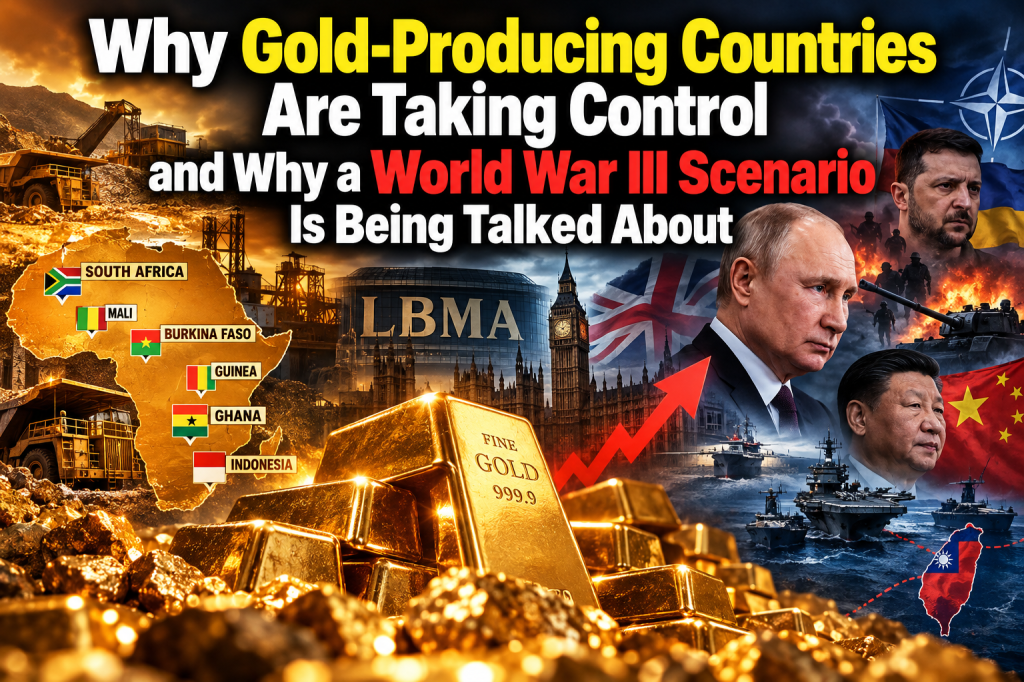
Something very different from what we see in the futures market has been happening.
There have been movements among gold-producing countries, and similar developments are now appearing in more and more places.
1. South Africa
When you think of gold, you think of South Africa. And when you think of South Africa, you think of gold.
So let’s start with South Africa, home to some of the world’s largest gold mines.
In 2023, South Africa’s precious-metals authorities and Ministry of Finance tightened controls over the domestic distribution and overseas export of unrefined precious metals.
Gold and silver began waking up around October 2022.
At the time, I entered the market because the charts looked as though something was about to happen.
Well… something was happening.
This clearly must have had an impact as well.
Exports became subject to prior approval.
To export unrefined gold below 99.9% purity, approval from South Africa’s precious-metals authorities was required.
Unless exporters could demonstrate insufficient domestic refining capacity, permission to export gold in raw form was effectively blocked.
In other words, unless domestic refineries were running at full capacity and there was literally nowhere left to process the gold…
No exports!!!
Ministry of Finance:
“There’s nowhere to refine it?”
Company:
“Nope~ Nowhere~ Looks like we have no choice but to export the raw gold…”
Ministry:
“Oh, really? Then pay a 7% tax!!! Or stand in line and wait~”
Company:
“What…?”
At current market prices, there’s nowhere on Earth willing to pay 7% more.
In practical terms, exports become impossible.
Through its 2024–2029 mineral-resource policy, South Africa shifted the core direction of its mining policy from exporting raw ore toward exporting finished and processed products.
For new or renewed licenses, companies are required to commit to processing a certain percentage of their production domestically.
Companies supplying physical gold to domestic refineries and the jewellery industry receive VAT refunds and tax benefits.
Meanwhile, authorities have been discussing an export levy on material that receives only primary refining before being immediately shipped overseas.
During the Boer War, Britain carried out scorched-earth operations in its effort to take control of South Africa’s gold resources.
And after Britain secured South African gold, the global gold price came to be determined in London.
LBMA.
The foundation behind it was South African gold.
But looking at South Africa’s policies today, it seems even the old unspoken pressure is being pushed aside.
The country is moving toward refining gold bars and manufacturing jewellery such as necklaces and rings domestically before exporting them.
The further this policy goes, the less material goes to refineries in Britain or Switzerland.
In other words, the probability of shortages at the LBMA — and at Switzerland, the traditional backup — gradually increases.
And of course, there’s the Krugerrand too. Haha.
The man on that coin was someone who tried until the very end to protect South Africa through negotiation and avoid war.
2. Burkina Faso / Mali
Following the 2023 coup governments, foreign mining interests faced policies allowing the government to take stakes of up to 35%, while export-permit requirements were tightened.
Construction of state-owned refineries became mandatory as part of efforts to domesticize refining, while licenses for exporting raw ore were suspended.
3. Indonesia
December 2025 — high export duties were imposed.
Depending on purity:
15%, 12.5%, and even highly refined material at 10%.
In other words:
Refine it domestically.
And even high-purity material was still subject to an export tax of at least 10%.
4. Guinea
June 2026 — exports of doré, meaning lower-purity gold, were completely banned.
A brand-new state-owned refinery was established.
From now on, only gold bars refined domestically would be allowed for export.
5. Ghana
September 2026 — exports of doré, meaning lower-purity gold, were completely banned.
All gold must be refined to 99.99% purity at designated domestic refineries before it can be exported.
Wow…
Not three nines.
Only four nines.
The central bank gets priority purchase rights over 30% of the production of major mining companies.
Basically:
“I get mine first. Then you can export what’s left.”
Look at what’s happening.
South Africa openly got the ball rolling in 2023.
Then other African countries started looking around and saying:
“Wait… we can do this too??”
And now they’re following one after another.
Good~~ Fighting!!!
Conclusion
① The supply of raw gold flowing into global refining centers such as London and Switzerland declines, increasing the production cost of LBMA gold bars.
② As export restrictions and tariff burdens increase, a gap emerges between the international spot price and the price of physical gold bars.
From Here On, This Is My Geopolitical Analysis — And My Scenario
1.
There is a very high possibility that Russia is backing South Africa’s actions and the similar moves now spreading across Africa.
2.
Why?
Because these actions hit Britain — especially its financial sector.
And that means touching Britain’s Achilles’ heel.
3.
Furthermore, there is no way Britain would have been completely unaware of a scenario in which the silver shortage in the second half of 2025 was followed by soaring gold prices and a potential inventory crisis.
4.
And look at what happened to France around the same period.
France was pushed out of Mali in August 2022.
Then out of Burkina Faso in 2023.
Then out of Niger.
5.
And what happened afterward…?
6.
The leaders of Mali, Burkina Faso and Niger all went to meet Putin.
South Africa is also a BRICS member, so naturally it maintains a good relationship with Putin.
7.
My view is that all of this is part of Russia’s effort to suppress the European financial interests that have long benefited from Africa’s resources — particularly its gold.
8.
From Africa’s perspective, it has been difficult to escape European pressure for a very long time.
But if Russia is backing them, they can nationalize their natural resources much more freely.
Now…
Do you understand what comes next?
Why Is World War III Being Talked About?
You cannot understand the full picture of international politics simply by listening to the “experts” appearing in the news.
Behind events like these is an enormous flow of money that makes those events almost inevitable.
And this, in my view, is the background behind why World War III is now being discussed.
Europe and Russia are moving toward increasingly extreme confrontation.
Europe’s strategy was to use Ukraine as the front line while attempting to isolate Russia.
But Russia’s counterattack is taking another form:
Push Europe out of Africa and use gold as a weapon against the financial system.
Rising gold prices receive overwhelming support from gold-producing nations — China, Russia, South America and Africa — while putting global financial powers increasingly under pressure.
A British member of Parliament says:
“Our missiles cannot penetrate Russian air defenses, while our air defenses cannot stop hypersonic missiles.”
Can we actually fight a war against Russia?
German media:
“Russia is producing its newest tanks around the clock, 24 hours a day. But they haven’t been sent to Ukraine.”
Tanks only move over land.
That doesn’t have anything to do with America, does it?
Where are they planning to use them?
Not against us… right?
And What About China?
If something bigger happens, China will also make a move.
China has unfinished business of its own.
British and American aircraft carriers and submarines are constantly moving around right in front of China.
From China’s point of view, that must be maddening.
But Taiwan’s military power, backed by the United States, is not weak.
And as long as Trump is there, direct military action would be difficult.
So if China acts, I believe it would be through negotiation, covert operations, or a blockade.
If something like this happens, the Taiwan Strait would be blocked.
And Korea, which depends heavily on surrounding maritime routes, could face an enormous economic shock.
There are already overseas reports suggesting that Korea could suffer one of the most severe economic impacts in the world under such a scenario.
The probability may be low.
But if something major happens in the Taiwan Strait, gold and silver prices in Korea could explode — and physical metal could disappear from the market.
A Note on Russia’s Financial System
Let me tell you something about Russian finance.
Russia has never been completely dominated by the global financial establishment and private creditors.
Why?
There are several reasons.
But here’s one that isn’t often discussed.
You know the KGB, right?
Spies around the world know what happens when you’re caught trying something against them.
They don’t execute you.
Execution is the easy way out.
During World War II, when Soviet forces entered Berlin, Germans desperately fled toward the American lines.
And Putin’s former workplace?
The KGB.
Imagine spending decades in the same organization, doing the same kind of work, and eventually becoming its CEO.
Wouldn’t you know everything about that organization?
Putin is operating with access to enormous amounts of information.
Of course, Russia did borrow money.
But just before Putin came to power, under Yeltsin, Russia essentially said:
“No money~ What do you want us to do?”
“We’re not saying we’ll never pay you. We’ll pay you when we have the money. Okay?”
Who didn’t know what was happening?
And who were the creditors?
Western banks.
The London Club.
Haha…
Western bondholders.
The Paris Club.
Haha…
Great.
“You know we survive by selling oil, right?”
“Oil prices are garbage.”
“If oil prices go up, we’ll be able to pay you back, won’t we?”
“Right?”
And then…
At exactly the right moment…
Oil prices surged.
And Russia ended up repaying its debts much faster than expected.
Coincidence?
Manipulation?
I don’t know.
Now Let’s Look at the Economy
Europe’s economy is in terrible shape.
The cheap raw materials Europe once obtained are no longer being handed over cheaply as African countries become increasingly independent.
Meanwhile, Chinese industry is taking over market share, and European industries — starting with automobiles — are collapsing one after another.
What about China?
China isn’t happily running its factories at full capacity because everything is booming.
It’s pushing products out to clear inventory.
The country is effectively in a depression-like situation.
And the United States?
As you’ve probably seen repeatedly in the news…
Rapid inflation is underway.
Europe has stagflation.
China has severe economic stagnation.
America has inflation.
When economies fall apart…
The war economy begins to stir.
Why Have Gold and Silver Been Rising Since 2023?
From the charts, I could see that something was happening.
But of course, I didn’t know exactly what was happening.
Only now are the reasons beginning to reveal themselves one by one.
2023
The major powers knew what was happening and began working on:
Reducing supply.
2025
Trump takes office.
The major powers begin the next phase:
Stimulating demand.
And this is where things become interesting.
Gold is the hydrogen bomb.
Silver is the nuclear bomb.
In other words, before detonating the hydrogen bomb, they tested the nuclear bomb first.
Gold is such an enormous market that creating a shortage is much more difficult.
Silver, on the other hand, is small enough to create a shortage.
So silver was simply tested first in 2025.
The world is becoming…
Very, very complicated.
So…
What should we prepare?
Two things.
First:
Prepare yourself mentally.
Second:
Gold or silver — whichever you prefer.
And I’m not talking about numbers displayed on a computer monitor.
I’m talking about the physical stuff you can actually buy from a bullion or precious-metals dealer.


댓글 남기기